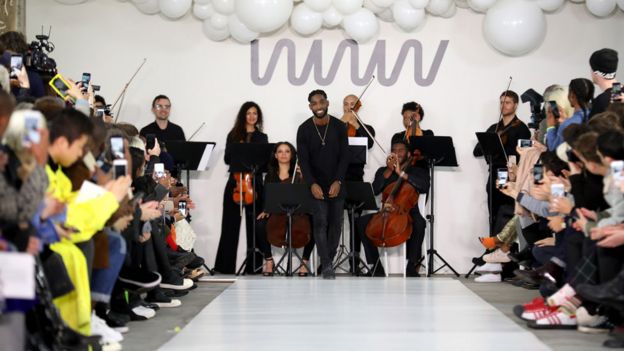
But with just days to go until Tinie Tempah's catwalk show for London Fashion Week Men's (LFWM), there's limited space at rehearsals.
Packed clothes racks and paper sketches fill the top floor room of the 29-year-old's studio in Holland Park, as models mill around trying on their outfits.
There's so much going on that the easiest (and quietest) place to conduct an interview turns out to be a small washroom, where we take shelter to discuss Tinie's latest collection for his clothing line, What We Wear.
The musician unveiled his first collection for the brand last year, but he has been an ambassador for LFWM since its launch in 2012 - a period he thinks was pivotal for men's fashion.
"I think 2010, 2011, there was a lot of press about how British men were becoming more fashionable. 'Metrosexual' was the term being used around the time," he tells the BBC.
Since then, more men have been paying attention to their fashion. To be honest, I still think there's a lot more women paying attention to what they wear, how they wear it, how it looks, who the designer is.
"But we're started to seeing a new generation of young people who are very savvy, more into their brands."
Since his huge breakthrough single Pass Out in 2010, fashion has been a crucial part of Tinie's public image.
His sharp sense of style led to him being named the UK's best dressed man in 2012 by GQ (he also appears in the top 20 of this year's list).
"I think there's more fashion in music than people realise," says Tinie, whose real name is Patrick Okogwu.
Most people who are shooting music videos, they're styled to some degree, there's some thought about what they're wearing, how their hair is styled. All of that, to me, is fashion.
"Even a fashion show itself wouldn't be right if there wasn't any music. I think there's a really close relationship between the two."
So, when London Collections: Men (later renamed to London Fashion Week Men's) first launched in 2012, Tinie was an obvious choice for ambassador. But his enthusiasm for fashion dates back beyond his music career.
"I'd say it was from about nine or 10. I come from a Nigerian immigrant background, my parents had us here, and my Mum, on top of having three or four jobs, she always believed in having a side hustle, and one of those was actually going and buying fabric," Tinie explains.
"In Nigerian culture, a lot of the women like to make their own dresses and wear them to weddings, so she'd buy all these different materials, and once in a while she'd let me go with her.
"From there, I started to understand and have a bit of a passion and knowledge for fashion and textiles in general."
Tinie's enthusiasm eventually encouraged to him become a prominent figure in the fashion circuit, working closely with the British Fashion Council.
"I remember just saying to myself one day, 'I can't come to another Men's Fashion Week for the sixth year running, being this guy that knows fashion, being this guy that's a clothes horse for most of these designers, and not make a contribution myself,'" he recalls.
"So while I was making my third album, Youth, it was a challenge for me to see if I could make a first solid collection as well as an album at the same time."


 Posts
Posts


No comments:
Post a Comment